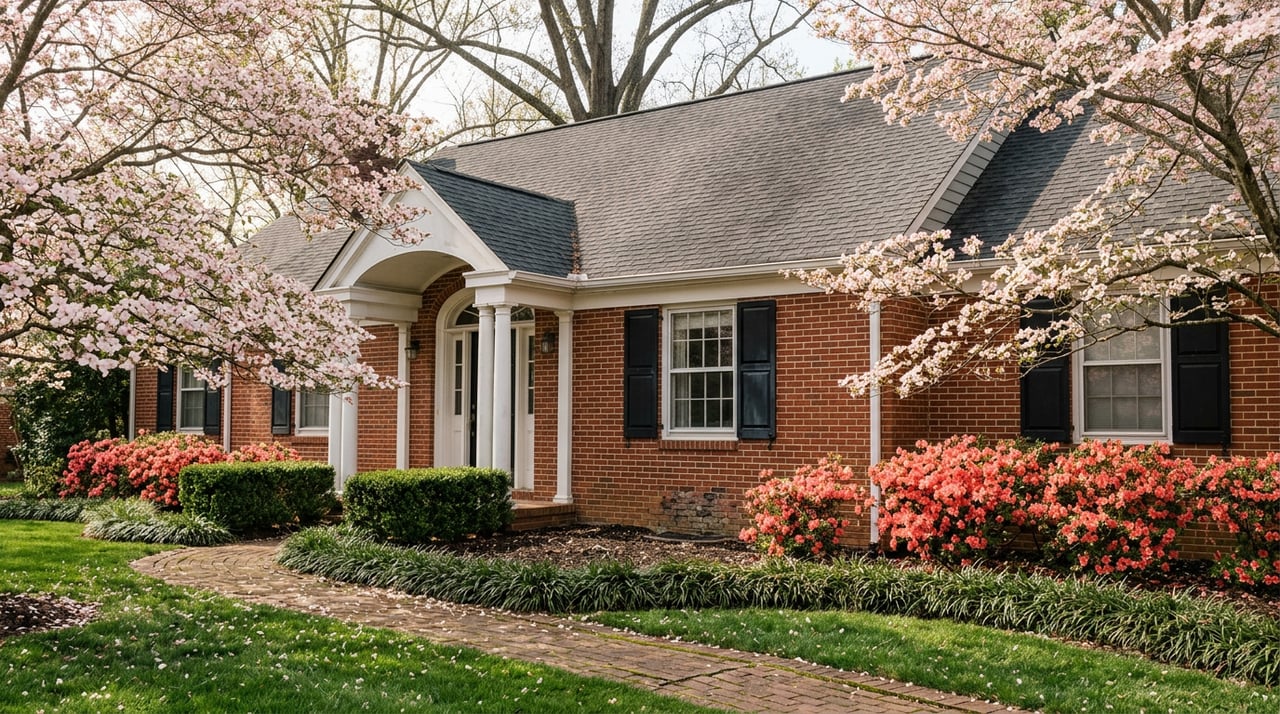
Sometime in the first days of April, a two-person crew works its way down Cherokee Boulevard with striping equipment and roughly 100 gallons of custom-blended pink paint. It takes three to four days with two crews doing the actual stripping, then another three or four for the arrows and the dogwood-bloom markings that follow the paved boulevard past Sequoyah Park. Anyone who has lived here through an April already knows the sequence: gray asphalt, then pink line, then the yard signs start going up.
What most residents don't clock every year is that this particular stretch of pavement isn't just one stop on a citywide route. It's where the whole thing started.
The Insult That Started It
In 1947, journalist John Gunther published a book that took a swing at half the country's cities, and Knoxville didn't come off well. He called it, in a phrase that stuck for decades, "the ugliest city I ever saw in America." The line landed the way insults from outsiders tend to land in a place that takes civic pride seriously: it got repeated and resented for decades.
Eight years later, in 1955, members of the Knoxville Garden Club, led by Betsey Creekmore and Martha Ashe, planted the first Dogwood Trail in Sequoyah Hills. Holston Hills followed in 1956, then Fountain City, Westmoreland, and Chapman Highway in 1957. Seven decades and a lot of pink paint later, the network the Garden Club started here now runs more than 90 miles through 13 Knoxville neighborhoods.
Why Here, Specifically
Sequoyah Hills wasn't a random pick. By the time the Garden Club needed a proving ground, Cherokee Boulevard already had the bones of a showpiece. Between 1927 and 1929, the neighborhood's developers had installed gateposts at both ends of the boulevard, two fountains known as Sunshine Fountain and Panther Fountain, stone benches, and a small park called Papoose Park. Those features are old enough now to sit on the National Register of Historic Places, and they were built without a single dogwood in mind. The trees came later. The stage was already there.
The street names carry their own layer of history. Cherokee Boulevard takes its name from the tribal lands it was built on, and the smaller streets branching off it, Iskagna, Agawela, Keowee, Taliluna, Tugaloo, pull from the same Southeastern Woodlands-era vocabulary. And running through the median, older than any of it, sits a 1,000-year-old earthen mound. The dogwoods that draw the crowds every April are, by a wide margin, the newest thing on this street.
First Doesn't Mean Featured Forever
Here's where it gets interesting for anyone who's lived through more than one April here. In 2024, marking the program's 69th year, Dogwood Arts staged its season-opening ribbon-cutting at Talahi Park, right on the original trail, and the press release named the location on purpose: "the first trail, established in 1955," according to reporting in the Farragut Press. That year, the ceremony came home.
In 2026, it didn't. The 2026 season's official ribbon-cutting happened at the Lakemoor Hills Dogwood Trail, with Mayor Indya Kincannon and Dogwood Arts' Trails & Gardens Program Manager Vicki Baumgartner on hand. That year's promotional spotlight, what Dogwood Arts calls its Featured Trails, went to Lakemoor Hills, Island Home, and Chapman Highway instead.
So the ceremony rotates. The origin doesn't. Sequoyah Hills doesn't need a press release to remind anyone it was first, and it doesn't lose its place on the map just because the cameras pointed elsewhere that spring. The pink line still gets painted down Cherokee Boulevard in early April whether or not a mayor shows up to cut a ribbon here.
How the 2026 Season Actually Ran
Looking back at how that spring unfolded is useful, because the shape repeats even when the exact dates shift by a week or two each year:
- April 1 through April 30: Dogwood Trails opened across all 13 neighborhoods, Sequoyah Hills included, with Open Garden and Camera Site yard signs marking which private properties welcomed visitors, daily from 10 a.m. to 6 p.m.
- April 11: The 18th Annual Chalk Walk took over Market Square downtown, with more than 300 artists working sidewalk panels from 8 a.m. to 5 p.m.
- April 18 and 19: That spring's Featured Gardens weekend opened three private properties to the public for a $5 donation each: Ross Glen Garden in West Knoxville, GATOP on Delrose Drive in East Knoxville, and Savage Garden in Fountain City.
- April 24 through 26: The Dogwood Arts Festival, marking its 66th year and recognized among USA Today's 10Best art festivals, filled World's Fair Park with roughly 100 juried artists, two stages of live music, and free general admission.
Worth noting: none of that spring's three Featured Gardens sat in Sequoyah Hills. That program rotates independently of the neighborhood's own longstanding Open Garden tradition, and it's easy to conflate the two. When a neighbor's yard has a sign out next April, that will be the original trail doing what it's done every year since 1955, not that year's citywide showcase passing through.
What the Season Actually Looks Like on the Ground
For anyone walking the loop that locals just call The Boulevard, April means sharing the crushed-stone path in the median with more foot traffic than usual, while cyclists take the paved outer ring. The route connects at its eastern edge to the Third Creek Greenway, so the crowd thins out or thickens depending on which direction you're headed. Sequoyah Park itself is split into three separate sections, each with its own parking, ballfields, a playground, and two points of access down to the Tennessee River, so there's room to spread out even during peak bloom weeks. Talahi Park, the smaller stone park just west of the main park, dates to the 1920s and its gated layout makes it the easier stop for anyone walking with young kids or a dog on a leash.
None of this changes because a given April happens to send the citywide spotlight to Lakemoor Hills instead of here. The paint crew still comes. The mound in the median still predates the neighborhood by a millennium. The fountains and gateposts still stand from a decade before anyone thought to call this a dogwood trail at all. Sequoyah Hills doesn't need the ribbon-cutting to prove what year this started.
If you're weighing what a neighborhood's traditions say about its long-term character, that's a conversation Ashley Wade has often, usually alongside the more technical questions about a specific house's condition or a renovation's return. Reach out any time to request your bespoke consultation.
